Baseball fans will probably love the new Turbo Tax commercial that features David Ortiz, also known as "Big Papi". Ortiz retired in 2016 season after a great career, mostly with the Boston Red Sox. He will likely be elected to the Baseball Hall of Fame. In this commercial, Ortiz has started a new career as a tennis instructor. As a hitter, he was famous for hitting home runs, after which he would drop his bat a admire his work. As a tennis instructor, he waits for the ball machine to fire the tennis ball over net, just as a pitcher would throw to the plate, He takes a huge two-handed baseball swing at the ball and knocks it out of the court, only to have it land hundreds of feet away somewhere in the tennis club causing destruction and chaos. Take a look.
Pretty hilarious I think. The music is Bach's "Air" from his Orchestral Suite no.3 in D major. It is one of the most recognizable and beautiful pieces of music ever written. I am usually always happy when classical music is used in commercials, films, TV programs, etc....But the producers of this commercial got it wrong if you ask me. I understand what they were attempting to do....Big Papi is at a snooty country club. They needed music to reflect this atmosphere, so they defaulted to classical, right? That's unfortunate. I have been saying all along in this blog that classical music need not be cast in that light. But even if you go along with it, THIS is not the piece to use. It does not fit that stereotype at all. The "Air" conveys...and this is my opinion of course...grace, understanding, peace, hope, redemption, and love. It is not stuffy and pretentious in any way, shape or form.
A swing and a miss for Initiative (Agency), and Wieden+Kennedy (Creative Agency).
I have this beautiful album from CBS Masterworks, part of a four volume set released in the mid-1980's. Glenn Gould died in 1982. He had just completed recording the Bach Goldberg Variations for a second time. His first recording of these was released in 1956 and catapulted him to fame. So much has been written and debated about Gould as a pianist, performer and person. It is interesting to hear so many different opinions about him. Was Gould crazy? Or just eccentric? Or both? I love the quote from conductor George Szell about Gould: "that nut's a genius." Funny....but maybe more than just funny.
Gould detested touring and performing. He, like the Beatles, finally just stopped. He gave his last concert in 1964. But fortunately for those living in Kansas City, he did make one appearance here, on November 23, 1962. Here is the review in the Kansas City Star from 11/24/62.
GLENN GOULD PLAYS
WITH RARE SKILLS
_________________
Pianist Appears Here in Program of Byrd, Bach, Haydn, Beethoven, and Berg
_________________
LIVES UP TO REPUTATION
_________________
Intense Canadian Performs Before 2,400 Persons at Music Hall
___________
By Clyde Neibarger
(The Star Music Editor)
As many critics have already commented, Glenn Gould is an extraordinary pianist. For an audience of about 2,400 last night at the Music Hall, the Canadian played, in turn, works of William Byrd, J.S.Bach, Haydn, Beethoven, and Alban Berg, and a Brahms encore number in a manner that already is marking him as a legendary keyboard figure.
His intense concentration is a thing to behold, as well as to listen to. Gould caresses the keyboard, except for the fortissimo passages, as in the Beethoven Sonata in E major, Opus 109, one of the composer's less-played numbers.
Members of the audience felt, evidently, that his choice of music represented the classical masters but in there lesser known works. One felt that the listeners would have accorded him bravos and a real ovation, had he played a number or two that they recognized and could identify without consulting the program.
Gould has a beautiful tone, especially in the softer passages, of which there were many. With a score before him at all times, he was an artist of remarkable gifts. His manner was somewhat eccentric, compared with the formal platform manner of most concert performers.
His program opened with a composition by the early Englishman, William Byrd (1543-1623) that sounded much like Bach, except that it had especially melodious passages. It was evident at once that Gould has modified his keyboard mannerisms since this this reviewer heard him in 1961 in Vancouver. Gould uses little pedal, which makes the effect cleancut. His left hand bounces off the keys in climatic episodes.
The Bach Partita was given some of his warmest intensity. One pedal foot was always forward, but he often had one foot or the other drawn backward as a part of the interpretive drive. As he played the faster passages, his body had a sidewise rocking motion.
The Haydn sonata, written about 1789, is in pure classical style, and Gould succeeded in making the Steinway's sound resemble that of the harpsichord of Haydn's time.
After intermission came Beethoven's sonata, then the one-movement Sonata, Opus 1, by Alan Berg, a pupil of Arnold Schoenberg. Berg's use of chords built on fourths was treated by him so that they were completely absorbed by the tonal structure.
An enthusiastic round of applause brought the artist back for an extra number, in the classical-romantic vein, the Brahms Intermezzo No. 3, Opus 117.
There had been times during the concert when people down front could hear Gould humming, and there were times when he seemed to be supplying words. He sat in a low chair, which made necessary arched wrists to level off with the keyboard from the lowered elbows.
Gould has talked of plans to give all his time eventually to composing, where he believes he could get the best results. This reviewer urges him to keep on playing, and as time permits, compose, too.
I was very fortunate as a child to have access to formal musical training as a violinist. The program I studied in was called the University of Texas String Project in Austin, Texas (I'm happy to say this program is still going strong forty-four years later!). Along with violin lessons, I also had classes in music literature and music theory. The part of music theory class I enjoyed the most was chord analysis...there are many ways to play or "voice," for example, a C major chord. Expanding on that, there are multiple groupings of notes that can be hard to determine just what they "add up to." I wish I was more proficient at diagnosing chords, so I supplement my lack of knowledge by asking Dr. Reynold Simpson, associate professor of music theory at the University of Missouri at Kansas City, for help.
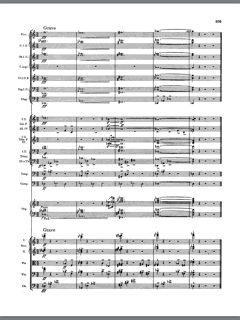
As I have stated in other "Great Chords" entries in this blog, when I listen to music, I am always on the lookout for cool chords....chords that stand out or have a particularly bold impact on me. Even just one chord has the power to shape or elevate a piece of music. This week, I re-listened to one of my all-time favorite pieces of music; Taras Bulba by Leos Janacek. This is an orchestral suite in three movements based on the novel by Nikolai Gogol. I have the score for this piece so I followed it as I listened. The chord I want to mention occurs in the third to last measure of the piece, following a large build and crescendo.(This awesome work also includes an organ which reappears for this finale.)
Here is what Dr. Simpson says about this chord: "You might think of this as a poly-chord, almost like Strauss' Elecktra Chord, except this combines an F-sharp dominant with an E-flat minor. The B-flat and G-flat of the E-flat minor chord are the same as the F-sharp and A-sharp in the F-sharp dominant, but the E-flat has a strong clash with the E-natural of the F-sharp dominant. The contrast of the chord is almost as odd as its placement in the harmonic progression as it inserts itself between the A-flat dominant and the D-flat tonic. Interesting sound."
If you have a piano, play an E and an E-flat at the same time. This will give you a simple idea of how this chord sounds.
American conductor Kenneth Woods wrote a great essay called "Janacek's blood-stained hands" published on August 10, 2010. http://kennethwoods.net/blog1/2010/08/20/janaceks-blood-stained-flowers/. Mr. Woods had just conducted a workshop in North Wales about Taras Bulba. His insights are fascinating. To quote Mr. Woods, "In Janacek, again and again we find chords and melodies that in other hands would simply be memorable-in his they become iconic and awe-inspiring."
And from this same essay, Mr. Woods lists several quotes from Janacek himself, including this:
"For me, the chord is a being full of life; a flower of blood in musical art."
Here is Taras Bulba performed by the Czech Philharmonic Orchestra conducted by Karl Ancerl (1961). In my opinion, this is the finest recording of this work, ever.
One of the things I like about most music streaming services are the suggestions that pop up for you based on previous music you have listened to. Or in the case of YouTube, videos you have watched. Awhile back, a video of a guitarist named Matt Palmer showed up as a suggestion for me. He was playing the Bach Chaconne, one of the great pieces of music in the violin repertoire which has been transcribed and performed by many guitarists. So I clicked it and was instantly impressed by the performance. Mr. Palmer plays with great emotion and passion, and is clearly a virtuoso on the guitar. I watched the Chaconne several times, and then explored other performances he has on YouTube. Many people commented that he is a well known and respected guitarist. I had not heard of him, but of course, being curious by nature when it comes to understanding what makes artists tick, I decided to try and contact Mr. Palmer to see if he would grant me an interview. I was very happy he returned my e-mail and agreed to talk. I called him on a Saturday morning after he went to his son's soccer game.
_________________________________________________________________________________
TH You answered
my interview request yourself….I was expecting a manger perhaps. Do you have an
agent?
MP No, I just do
it myself.
TH Cool. Where do
you live?
MP I live just
outside of DC, on the Maryland side…a place called Bowie.
TH Have you ever
been to KC before?
MP Yes, I played
there about 3 years ago…with the Kansas City Guitar Society and Doug Niedt.
TH A good friend
of mine, John Svoboda, studied with Doug Niedt.
MP I know that
name...I’ve heard of his work.
TH What brought
me to you was a video that popped up on my YouTube suggestion list….your
performance of the Bach Chaconne. That blew me away. Did you hear classical
music or guitar music in your home as a youngster?
MP No I didn’t.
It was all later. My firstexposureto
classical guitar….do you remember those subscription deals for CD’s where you
could get 5 CDs a month or something like that? My mom had one of those…
TH Yes…Columbia
House club.
MP Yeah...that’s
what it was. And so she was on that and occasionally she’d get me something. It
was kind of hit and miss if I would listen to it or not. She got me this
classical guitar CD...a Christopher Parkening two disc set from that. It’s
true…I’ve said it before…I put it in my closet and didn’t listen to it…didn’t
even open it. I was in high school at this point…16-17 years old, and at that
point I was all in on electric guitar and heavy metal, hard rock. I was in a
band playing bars, having a great time with it. I’d say I was a very serious
guitarist at the time. I played all the time. If I went to a party in high
school, I’d show up with my guitar. Everyone knew me from that. But maybe two
years later, I’d gone through a phase where I was listening to new music…it
wasn’t new at the time, but new for me…some Al Di Meola…that thing where he
played with Paco de Lucia…Friday Night in San Francisco. When I heard that, I was hearing nylon
strings, and it sparked my interest a bit. But then I recalled the CD my mom
had given me and I got it out and listened to it and it was a “eureka” moment.
Hearing Asturias and Recuerdos de la Alhambra…these staples in the classical
guitar repertoire that can easily draw in an audience …that’s what drew me
in...Asturias and Alhambra and other tremolo pieces. At the time, I didn’t read
music or anything. This was before you could look up tabs on the internet, so I
just did it the old fashioned way and transcribed them by ear.
TH When I first
heard these pieces…with the tremolo technique, it sounds like two people
playing rather than one. How were you able to pick that out?
MP Well, at first
I thought it was two people (laughs) but I read the liner notes and found out
it was a technique. The way I originally did it was wrong. The tremolo is a
sequence…its thumb, ring, middle, index…thumb
playing the bass notes and the three fingers playing the melodic tremolo line.
I mistakenly thought he was playing thumb and pinky together…thumb and pinky
together and then ring, middle, index after that. So I learned it all by ear…I didn’t have a
teacher...and I grew my nails out about an inch long. I auditioned for college with
Recuerdos and Asturias and the BWV 1001 Fugue for violin by Bach. All by ear.
TH You did not
know how to read music at all?
MP I was not able
to read music, but I could read tablature of course, but classical guitar in
tabs at the time was basically unheard of.
TH Did you still
keep your feet in the electric guitar world at that time?
MP There was a
period when I first started doing this...I was approaching twenty, probably
nineteen… when I started doing this. I was out of high school. I wasn’t going
to college…I had no plans on going to college and I was still in a band playing
shows. I was moonlighting as an aspiring classical guitarist just working out
the fundamentals of finger-style guitar and learning these great tunes that I
had fallen in love with as soon as I heard them. Not very long after that I
learned that you could study guitar in college or at a university. I learned
through my brother that Bill Yelverton at Middle Tennessee State University was
holding auditions for guitarists in his studio. The audition went OK. I don’t
recall him being particularly impressed…and I don’t blame him. He’s listening
to a guy with one-inch long nails and no real training.
TH You weren’t
the next Segovia at that point? (laughs)
MP I was not
(laughing), but I did get a small scholarship
that I was very happy to have received.
TH I’m struck by
how late you really got your start with classical guitar. There are eight year-olds who can read music and have had more formal training that you had at
twenty.
MP I think it was
late. For instance, by the time I was good
enough to do well in competitions, I didn’t want to do it anymore. (laughs) I
was past that competitive phase. By the time I got good enough I just wanted to
make music. When I started my Doctorate I was almost thirty years old. A lot of
other guys were a few years younger than me.
TH How old are
you now if you don’t mind me asking?
MP I’m
thirty-eight.
MP After MTSU I
went to Boone, North Carolina to study at Appalachian State University. And I
got my doctorate from the University of Arizona. Professionally, in the last
3-4 years, my performance career has taken off in a more substantial way. With
other guitarists, this may have happened some years earlier.
TH You mentioned
hearing the Christopher Parkening CD was a watershed moment. What was your
first real memorable musical moment?
MP I had a few. I
was exposed to guitar in general. My dad was a guitarist. He played a 12-string
guitar, harmonica and sang…more of a folk-style. So I always did enjoy hearing
that as a kid. He died when I was young, just before I started to play. Right around
the time I was ten or eleven years old was when Appetite for Destruction (Guns
N’ Roses) came out. My older brothers and I were immediate fans and we had to
have a guitar that Christmas. Fortunately we got one and we shared it.
TH What kind was
it? Was it a Les Paul like Slash played?
MP (laughs)
No…much cheaper. I think it was an Applause. We loved it. We didn’t know the
difference at the time. We were just happy to have had it. Eventually we all
had to have our own. Pretty soon after that I did hear Randy Rhoads...Ozzy Osbourne’s Tribute Album. For years,
Randy Rhoads was my favorite guitarist. I learned that entire Tribute Album and
played it from beginning to end right along with them…barely hanging on with
him. He was a great player…very inspiring. Who knows, maybe that very early
seed of classical guitar was planted by him because I did play that song he
wrote called Dee. I did play that but I just kind of hacked my way through
it…it was a little classical tune he wrote.
TH He’s an
example of a musician who found his way to classical music. Ozzy has said if
Randy was still alive, he might very well be a classical guitarist now.
MP I think very
likely. I think he did have plans to hang it up (rock) and study classical
guitar at a conservatory. Early on I really sucked (laughs). My brothers were
sure to tell me that too. They were a little older and caught on a little
faster. I remember just trying to play some songs but nothing seemed to be
clicking. I was frustrated over some silly song I was trying to play...hard
rock song…it was just basic power chords in open position. I couldn’t even do
that. I remember sitting on the couch one day watching TV…I must have been
eleven or twelve at the time…and I was thinking about this song that I couldn’t
play, but I really wanted to play it and I just started working my fingers
playing air guitar. And within a moment I realized I had it. And I’ve always
thought of that as one of the biggest breakthroughs I’ve ever had on the
guitar…playing air guitar.
TH A breakthrough
because of air guitar!
MP Yeah…and
honestly from there I never really felt completely frustrated over anything
after that. There’ve always been challenges. At the time I had a grim outlook
about my future on the guitar, but after that moment…never. I could always do
what I tried to do after that.
TH I know in the
violin repertoire, there may not be anything more difficult than the Bach
Chaconne. Is the same thing true for this piece on the guitar?
MP I think the
Chaconne, and violin repertoire in general, fits my playing style really well.
I definitely acknowledge it’s a difficult piece, and I enjoy playing it. The main difficulty for me is that it is very
emotionally draining.During a
performance I am putting everything I have into every note that goes by, and I
get to the end and I really feel it. You have to take a deep breath and let
your mind rest a bit.
TH It’s
exhausting as a listener too. It is a transformative piece. I remember a great
video of Itzhak Perlman playing it. When it’s over, he is covered in sweat and
he is completely spent. It’s such an emotional piece.
TH What other
classical guitarists would you say have been influential for you?
MP My original influence was Parkening, who was a student of
Segovia. And there’s a Brazilian guitarist, Fabio Zanon, whom I had a CD of
playing the complete works of Villa-Lobos that was very important to me. Julian Bream is another special player…always
emotional and entertaining…never a dull moment when you listen to him. Some
other players over the years who have inspired me would be Lorenzo Micheli, and Matteo Mela, whom I just had the
privilege of hosting here at my guitar festival over the weekend. They play a
duo now, but as soloists, they were some of the first guitarists I heard play. Another
player would be Aniello Desiderio. And
then of course my main teachers, Bill Yelverton, Doug James and Tom Patterson,
who each gave me the exact guidance I needed during their time. All the guys I’ve mentioned I think also
introduced me to the concept of “being your own artist.” Find what you do well
and focus on that and go all in. You develop a vision for every piece you are
going to play and you go all in, despite what anyone else might say. My
Chaconne for instance may be a good example. I think from chord one, you know
you’re hearing something different.
TH I was
impressed with your technique and speed.
MP That comes
from the seeds of playing thrash metal. I always tell my students, to play fast
you have to be able to think fast. And growing up, I always heard things really
fast.
TH Now that you
are successful and spend your time making a living as a musician, do you still
enjoy listening to music?
MP I do enjoy
listening to music. Not a lot of classical guitar these days. If I listen to
classical guitar, I feel like I’m almost doing research. I also record too…I engineer all my own
recordings...it’s one of my hobbies. I’ve always been a do-it-yourself kind of
guy. So I find myself listening to sound
quality…
TH You’re
analyzing it…
MPYeah, it’s hard to separate from that when I listen to
guitar. Often I find myself just looking for songs I might want to play myself.
I may listen to more piano music than I do guitar. I listen to a lot more Tom
Waits than I do anything else. I am captivated by his music. It’s very
emotional and poetic.
TH I love his
tune “You’re Innocent When You Dream.”
MP I have
probably 25 Tom Waits albums. I can say I really like a lot of artists, but I
am a Tom Waits fan.
TH Do you still
listen to Guns N’ Roses, or Zeppelin?
MP I don’t. I
still have a pretty decent collection…some friends were in town recently and we
pulled out some of those albums. It’s surprising how much you remember of that
when you haven’t listened to it in twenty years…you still know all the lyrics
and I could probably pick up the electric guitar and still play it, but I don’t
revisit that stuff very often.
TH When was the
last time you played your electric guitar?
MP I still have
my electric guitar. I did go a period of about ten years without touching one
at all. I made a deal with myself that I have already
broken, that I would pick it up once or twice a week and practice on it. There
is something about that left hand…when you play an electric guitar… that ease
of motion that I think you get away from on a classical guitar because it’s a
more difficult instrument to play physically. I found practicing on an electric
guitar can really free up my left hand on the classical. I just don’t have the
time to devote myself to that.
TH I am happy to
hear you still like to listen to music. I’ve talked with many musicians who
tell me the last thing they want to do is listen to music because that’s what
they do all day long. I think that’s kind of sad. So if you had to go to a
desert island and could only take the work of three composers, who would they
be?
MP I’d bring late
Beethoven String Quartets. I would bring solo piano works of Scriabin. And the
Shostakovich String Quartets too. And Tom
Waits.
TH Do you
transcribe music?
MP Yes…in fact I
transcribed a few pieces by Scriabin. One of the Canons I did of his is on
YouTube. But a lot of the great stuff by Scriabin wouldn’t really fit the
guitar. The harmonies are so extended and they require quite a few notes or
multiple voices. There have been
arrangers and transcribers who have captured the essence of a lot of the great
composer’s works, and that’s at the heart of making a great transcription…to
capture that essence. But the essence of some of the composers I like isn’t
often in harmony. Some of those harmonies are impossible to play on the guitar
unfortunately. And some of the counterpoint too. But
I have some pretty good Tom Waits arrangements that I’ve done as well.
TH There’s a
French guitarist who has done some amazing transcriptions…Roland Dyens. He has
a wonderful version of Tchaikovsky’s piece “June” from the Seasons.
MP I have that
actually…I have the score. I hope to learn it at some point. It’s a really
beautiful piece. That type of piece fits well on the guitar…melody and
accompaniment; that’s what the guitar does the best. And romantic style
harmonic languages fit really well on the instrument.
TH With your
schedule these days, do you still have much time to practice.
MP As a student,
I would practice 5-6 hours a day…without fail for 20 years.
TH No wonder you
turned out as good as you are!
MP These days,
since finishing my doctorate and teaching a lot, it’s a little different. But I
take every opportunity I’ve got…even the middle of the night when the kids are
in bed I can find a couple of hours. My key to maintaining a decent practice
schedule is to sleep less (laughing).
TH Do you work
out or do anything special to keep injuries away?
MP I’ve been
pretty fortunate not to have anything major happen. I occasionally get a little concerned with
soreness or a tingle here or there. I always have to make sure I am positioned
correctly on the instrument. And I gauge the amount of practice time I’m
getting. And never jump into a new piece too fast before training my fingers
what to do. That’s when you expose yourself to injury…making a big shift or quick move without being mentally and
physically prepared. And I try to stretch before I start playing…and making sure
my hands are warm before I get started.
TH Do you enjoy
playing with an orchestra…i.e. the Rodrigo Concierto de Aranjuez?
MP I think I
might be better as a soloist, but I do enjoy playing with an orchestra. I’ve
played the Rodrigo three times. And the Brouwer Elegacio Concerto. Here’s a
great story. I was playing the Brouwer at Milligan College in Tennessee, and
there is a big thunderstorm outside. We make it to the first cadenza…everything
is really going great….I’m really enjoying playing with the orchestra, but
right after the cadenza, the power goes out. Its pitch black except for a light
off stage. Complete darkness for everyone else. So the orchestra does not come
in on their entrance, so the maestro announces to the audience, “it’s obvious
that Matt can play his part in the dark, but the orchestra cannot.” He knew I
had a solo repertoire I could play, so I ended up playing about 45 minutes in
the dark…solo…for the audience. It ended up better that way. I was getting a
standing ovation after every piece! It’s a great story. Everyone who was there
will always remember that much more than a regular concert.
TH They will
remember that forever! Did the power come back on?
MP It did. We
started right where we left off…..but the highlight was the power going out.
TH Here are some
non-musical questions for you. Are you a coffee drinker?
MP I’m drinking
coffee right now!
TH Do you like
good coffee…I mean not Folgers etc…
MP I like really
good coffee. I’m not super picky about it as long as it’s decent. I’m drinking
some Chock Full O’ Nuts right now. You get this huge can at Costco…
TH Do you grind
your own beans?
MP I like to do
that too. I think I could get into roasting my own beans. I just played a
concert in Michigan over the summer where a guy I met who definitely was a
coffee aficionado roasted his own beans. I could totally get into that.
TH Do you drink
beer?
MP I do drink
beer…not as much as I did in high school. I am more of a craft beer drinker
now.
TH And I see you
are sponsored by a guitar string company? Do you want to put a plug in for
them?
MP Yeah…I am
sponsored by D’Addario.
TH What gauge or
type do you play?
MP Right now I’m
playing their Dynacore basses. And two of the carbon trebles and my high e
string is a titanium treble. A mixed set.
TH Have you
played Carnegie Hall?
MP Yes, three
years ago as part of the D’Addario concert series. I
took that gig on four days’ notice. I was down in my basement fixing a wall in
my recording studio and the next day I was on a plane to New York. (laughs)
TH What an
amazing honor to be playing at Carnegie Hall I would say.
MP It was great
and the people there were so supportive. It was such an honor for me that
D’Addario invited me there to play.
TH How were the
acoustics?
MP It was a
really clean and pure sound. Not too much reverb coming back or sound bouncing
around. And I’d do it again…on even a day’s notice!
TH Thank you so
much for your time. It’s been a real treat to speak with you.
I like a good mystery once in awhile. As you may remember, I play the violin in the Heritage Philharmonic. Last week at rehearsal, our conductor, Jim Murray, told me that one of our trumpet players, Danny Lane, had something exciting to share with me that I might want to write about. It was a postcard advertising a concert by Ferruccio Busoni in Sedalia, Missouri on Friday, March 10th....but no year is given. But in very faint writing on the back of the postcard, someone wrote 1911 and 1916.
Now, I will be honest that other than having heard his name, I knew little, if anything, about Busoni. So I looked him up and learned that he lived from 1866-1924. He was one of the greatest pianists of his time. He knew Liszt, Brahms, and Rubinstein. He was also a prolific composer, arranger, transcriber, conductor and teacher. He toured extensively, and found his way to Sedalia, Missouri. But when?
I live only about an hour from Sedalia, and on my my home from a work trip to St. Louis this weekend, I stopped at the library in Sedalia hoping to learn more about his visit. I googled the calendars for the years 1911, and 1916, and March 10 was a Friday in both of those years. Someone had already figured that out and that's why it was written on the card. So when I got to the library, I asked the librarian for the 1911 and 1916 Sedalia Democrat-Sentinel newspapers. They are on microfiche, and she disappeared for a few minutes to locate them. She returned with 2 boxes and we sat down to load them onto the reader. We started with 1911. In a few minutes I saw this:
So I knew it was 1911, and as I flipped through the pages, I arrived at this:
Another promotion, this time with his picture and full name: Ferruccio Benvenuto Michel Angelo Dante Busoni.
And then a bit later I found the review of his performance, published Sunday, March 12, 1911:
TRULY A MUSICAL TREAT
_______
The Great Busoni at Sedalia Theater Friday Night
_______
One of the greatest triumphs that the Ladies' Musical club has ever achieved was the giving to Sedalia music lovers the opportunity of hearing the world renowned pianist Ferruccio Busoni, Friday night. And right well did the Sedalia public support the ladies in their effort, for never was there in the new theater a more representative assembly, and Mr. Busoni said he had rarely played to a more appreciative, attentive or beautiful audience.
Sedalia society was out in force, and the ladies in the audience and boxes never presented a handsomer appearance. The surrounding towns sent large delegations-Warrensburg, Columbia, Boonville, Tipton, Cole Camp, Damonte, and Fayette were represented.
The heads of the musical departments of the various colleges were all here, showing their appreciation of the rare opportunity of hearing so great an artist.
Of Busoni too much cannot be said in his praise. The critics have united in pronouncing him the greatest pianist now living, and it would be fulsome to try to add to what has already been written of the wonderful genius of this wizard of the piano forte.
He first played the great masterful Waldstren sonata (the reviewer meant Beethoven's Sonata no. 21 in C major, "Waldstein.") filled with soul melodies, then showed his mighty skill, technique and mastery of the piano in the Brahms-Paganini variations, and followed this with the tender, beautiful C minor Chopin Nocturne and the great Polonaise by the same master. His last group was made up of the beautiful Campanella, the Erl King and Rigoletto-all transcriptions by Liszt, and in these he had opportunity for showing every requirement which goes to make up the great pianist, and in each and every one he was all that could be desired.
His audience sat spellbound and the only regret expressed was that Mr. Busoni did not respond to the enthusiastic encore which the audience demanded after every number. But this was owing to the fact that that for several days he had been very ill and at 4 o'clock in the afternoon he feared he would not be able to fill his engagement that night, and at the close of his program was so prostrated that he was physically unable to play again, and expressed regret that he could not do so for an audience which was so sympathetic and appreciative.
Mr. Busoni has a reputation of being one of the most generous of the great artists with regard to giving encores and it was only because he was ill and unable to do so that he did not respond to the enthusiasm of the audience Friday night.
From every point of view the Busoni concert was a grand success, and the Ladies' Musical club is again to be congratulated upon another musical and artistic triumph.
________
I've done some more research and found out that Busoni played in Kansas City in 1915. I don't have the review yet, but I will try and find it soon. But I found found this advertisement in The Piano Trade Magazine, Volume 12 (1915):
The caption below this reads "This is an advertisement put out by the Carl Hoffman Music Company sometime ago when Busoni played the Chickering in concert in Kansas City." Looks like Carl Hoffman was at 1120 Walnut Street. The postcard above for the Sedalia recital also mentions that Busoni was playing on a Chickering piano there as well.
Lots to weave together here in this entry. Here we go. I was a violinist in the Omaha Area Youth Orchestra in 1982. Our Music Director, David Hagy, had set the upcoming season's music on the stand before our first rehearsal. The morning of our first rehearsal, I took my seat (3rd chair, First Violins) and opened the folder to see what pieces we were playing.
Fanfare for Brass and Percussion - Erb
Academic Festival Overture - Brahms
Adagio for Strings - Barber
Suite for Chamber Orchestra - Stravinsky
Star Wars Medley - Williams
Scheherazade - Rimsky-Korsakov
As I looked through the music, I'm sure my jaw hit the floor. There were so many notes to play! Fast notes, high notes.....endlessly mashed up on every page. It was going to be a long season I thought...learning to play all of these notes. I wondered if Mr. Hagy has lost his mind??? These were hard pieces...and the mother-ship was Scheherazade. It was like a book on the stand. Sure, we were a pretty good youth orchestra, but surely this piece was too big for us to play. I went home feeling pretty overwhelmed.
Rimsky-Korsakov composed Scheherazade in 1888. It is a symphonic suite based on the Tale of One Thousand and One Nights, or The Arabian Nights. It is one of the most well known classical works of all time. And it's one of the best. Throughout history, composers, songwriters, painters, and writers have sought to capture the natural world in their works. Scheherazade is a wonderful example of art capturing the sound, feeling, and sensation of the ocean. The opening statement of the work is a short chord passage of brass and woodwinds, followed by that iconic solo violin which then leads to the rolling cello and bass line that brings the sea to life musically. Layered on top are such delicious chords in the brass. It really is amazing, and I think it's one of the best musical representations of the sea ever written. How did he do this?
In 1862, a young Rimsky-Korsakov served as a midshipman in the Russian Navy aboard the vessel "Almaz". He entered the Naval College in 1856, where his interest in music was allowed to flourish. But upon graduation in 1862, he was forced to put music on hold. His ship sailed on November 2, 1862 on a voyage that would last almost three years. As I learned in a biography of Rimsky-Korsakof by M. Montague-Nathan (1917), "As may well be imagined, the long foreign cruise contributed very little to Rimsky-Korsakof's musical development, though as has been conjectured by more than one writer, the wonderful tonal pictures of the sea, painted by him in such works as "Sadko" and "Scheherazade," were undoubtedly inspired by impressions gained afloat."
I worked very hard to learn all of the notes for our 1982 concert. Each rehearsal was unrelenting. We practiced small segments over and over. Month after month went by without any sense of the "whole." It was pretty frustrating and as we came close to our Spring tour, it seemed like we were in for a disaster! We had raised enough money to take a tour to the East Coast...Philadelphia, Washington D.C., and New York City, and then home for our triumphant final concert at the Orpheum Theater in Omaha. I was excited about the trip, but terrified about playing Scheherazade.
In October 1863, the Almaz docked in New York Harbor. During his time in America, Rimsky-Kosakov saw two operas; "Faust"(Gounod) and "Robert" (Meyerbeer). He also went to see Niagara Falls. Perhaps of greater historical importance though, the Russian Fleet was playing a role in the Civil War that was raging all around him. Here is a wonderful article by C. Douglas Kroll that was published in 2013 in Russia Beyond the Headlines:
Back to 1982...the Omaha Area Youth Orchestra embarked on it's tour in June. Our first stop was at Drake University in Des Moines, IA on June 9th to be exact. This was our first performance and we were all very nervous. We had not played the entire concert straight through to this point. I still had no idea how and if we could do it! Maestro Hagy was very wise though, and he had prepared us much more than any of us knew. From the downbeat of the Brahms, we were off and running, and we survived even the Scheherazade. I'm not going to lie, it was a bumpy ride. There were plenty of mistakes and missed turns. But we made it through and it gave us confidence that we cold pull this off. The next night in Indianapolis, we performed at Butler University. This performance was much better than the previous night. Scheherazade was still shaky, but it was beginning to take shape.
We left Indy the next day and drove to Morgantown, West Virginia for a performance at Fairmont State College. Compared to Drake and Butler, Fairmont seemed far less sophisticated. Our performance was in a cafeteria...at least that's the way I remember it all these years later. By this point, we were all pretty tired, and the thought of getting psyched up to play in a mostly empty cafeteria did not seem like much fun. But we set up and prepared to play. When it was time for the concert, a strange thing happened. People began to fill up the seats. It seemed like the entire town had come. It was standing room only. I remember the audience was almost close enough for me to touch with my bow...they were right on top of us. And they were ALIVE and EXCITED. Coal miners, bankers, farmers, professors, their families...it was quite an eclectic audience. And from that point on, when Maestro Hagy gave the downbeat, we were a different orchestra. I came alive as a musician that evening. I wasn't over-thinking. I was just playing...trusting myself and my stand partner...the entire orchestra for that matter really came to life. And something truly magical happened in the Scheherazade. Not only did we hit the right notes, we brought the sea to life....we made music. I will always remember stealing a glance to my right to see an older gentleman sitting right across from me towards the end of the piece when we return to the glorious "sea theme"... it's a triumphant moment and we were blowing the roof off the place...and he had a look on his face that was priceless...his mouth had dropped open and his eyes were as wide as saucers. I think my face looked the same way. The hair on the back of my neck stood up and I could feel tears forming in my eyes. It was a powerful experience that has never left me. That's the power of music.
We played well the rest of the tour, and our final concert back home in Omaha at the Orpheum was also a huge success. I will never forget this concert tour nor the experiences...both high and low...of bringing such an epic work as Scheherazade to life.
And of course after his service in the Russian Navy was completed, Rimsky-Korsakov returned to music and became a famous composer. The article above indicates the Flight of the Bumblebee was also born as a result of his experience at sea.
Here is a great recording of Scheherazade. Thee are many to choose from, but this is as solid as they come.
And here is a fun recording of a jazzy version of Scheherazade courtesy of guitar virtuoso, Frank Vignola. I saw him play this at the Folly Theater a few years ago and it was awesome!
A new commercial for Gucci Guilty (a cologne) features Gustav Mahler's Adagietto (from his Fifth Symphony) as the musical backdrop. Actor Jared Leto is the star of the ad. (Loved him in Dallas Buyer's Club). But this commercial really sucks if you ask me. I don't know what's going on and it's "style" or attempt at "style" falls flat. It is stylish shit.
That being said, Mahler's Adagietto is one of the most beautiful pieces of music ever written, and even if it is part of a horrible ad, at least Mahler's music is given an appearance in mainstream media.
Mahler wrote the Adagietto for his wife Alma....a love song of symphonic magnitude. Maybe I'm Amazed by Paul McCartney, Layla by Eric Clapton and Something by George Harrison are beautiful love songs. But as great as they are, they are dwarfed by what Mahler composed for Alma.
The Adagietto is part of Mahler's Fifth Symphony...the fourth movement. It was composed in 1901-1902 and premiered in 1904.
I did some digging to see if there was any real world connection between Mahler and Gucci. They were contemporaries.Gucci lived from 1881-1953. Mahler lived from 1860-1911. I can't find any reports that they actually met or that Gucci heard any of Mahler's music, though I think there is a chance he did. Both men visited London, but not at the same time. Mahler was there in 1892, and Gucci lived there from 1898-1905. Gucci moved back to Florence, Italy to start his company in 1905. Mahler visited Rome in 1907 and conducted the Adagietto in a concert there. It is possible Gucci could have taken a train to Rome for that performance.....