Saturday, May 3, 2014

I Heard Violins

Things changed for me big time in the Spring of 1973. I heard violins....up close. I was in 3rd grade, and a string quartet from the University of Texas String Project came to give a demonstration at Pillow Elementary School. I knew right then and there I wanted to learn to play the violin. And thanks to my parents, I soon began taking lessons....and the rest is history.
I had, of course, "heard" violins on recordings before that fateful day, but it was my fist experience holding one...trying to play one...and most importantly, hearing it right next to my ear as I held it under my chin and scratched the bow across it. I was....and still am...in love.
Violins are everywhere...in every kind of music. Paganini to Charlie Daniels. Brian Eno to Metallica. Sinatra to Stephan Grapellli. You name it.
The versatility of the violin is amazing and very special if you ask me. The best part of the Beethoven Violin Concerto is????.....the violin of course. The best part of Johnny Mathis's classic hit Misty? Well sure, his voice is awesome....but the background strings tie it all together if you ask me. How about the Verve's hit song Bitter Sweet Symphony? Right....the strings steal the show! When Frank Sinatra teamed with the Hollywood String Quartet and arranger Nelson Riddle, they created that amazing sound that became the basis for his legendary Capitol Records recording period.
So I plan to share great examples of violins in all kinds of music as part of this blog. Let's kick things off with Close to You, as recorded by Frank Sinatra in 1943.

https://www.youtube.com/watch?v=ZxKf2STt-mc


Saturday, April 19, 2014

Playlist Suggestion

Ottorino Respighi wrote the Symphonic Poem, The Pines of Rome in 1924. This is part of a "trilogy" of Roman poems along with the Fountains of Rome and Roman Festivals. I recently wrote about certain works and performances that lend themselves to climactic moments when the hair on the back of your neck stands up and your spirit soars with the power and emotion of the piece. This is one such piece. The last 5 1/2 minutes are stunning. Have a listen. This is a very good performance that is available on YouTube.
http://youtu.be/TQwGTe_MueM

Thursday, April 10, 2014

As the Beatles proved, it's not about Education.


I spend a lot of time thinking about ways to increase the popularity of classical music in today's world. As I said in one of my earliest posts, it's a fact that very few Americans listen to classical music. Period. And historically, classical music sales are a tiny fraction of the overall pie. Those of us who love classical music have tried to understand and explain this for generations now. What I find to be the most fulfilling and joyous of all musical forms is unknown or unappreciated by most people. I hear most experts and music educators say education is the way to expand the understanding and appreciation of classical music. But they have been saying that forever, and it has not changed a thing. I have made up my mind: loving classical music does NOT require any specific education ....it's not ABOUT education. In some ways, I think this school of thought hurts classical music. Saying you need "education" to enjoy something makes it seem out of reach....exclusive.....cut off. Sadly, classical music has earned this label, at least here in America where many feel it is for the rich....for "snobs". And face it, many of the traditions of classical music put it in this box. (Performance tuxedos are a good example).
Back in February 2014, America celebrated the 50th anniversary of the Beatles' performance on the Ed Sullivan show....the beginning of Beatlemania....a revolution in music, style and popular culture. When those 4 young men (or "lads" as they were called) took the stage and played, no one needed any education to love what they heard and have their minds blown. What they were seeing and hearing changed everything! And it just happened.....no explanation, preparation, nor education....just BAM. Pure. Simple. Fun. Amazing. I discovered the Beatles 14 years after that night (also covered in my first blog entry). And for me in 1978, the result was the same.The Beatles blew my mind. BUT, I experienced the SAME profound moment the very first time I heard Vivaldi's Four Seasons....and Beethoven's 5th Symphony....and Bruckner's 8th Symphony, and Mahler's 5th Symphony, and Strauss' Death and Transfiguration, and Mozart's Eine Kleine Nachtmusik......etc, etc, etc......they all blew my mind. And education had nothing to do with it. I heard it....and I loved it. WHY? I suppose that's the mystery. A Schubert Piano Sonata or "I Wanna Hold Your Hand"? They are both great in my mind.
Maybe the challenge is to get classical music in our ears without having to look for it. I don't see much, if any, classical music on live TV...or any TV for that matter. (It's there....but you do have to search for it). Please don't tell me I am an education hater! I am not saying education is not important, valuable, fantastic......none of that. I love education. Just like the motto of Faber College in Animal House...."Knowledge is Good".
But classical music can be enjoyed by anyone and everyone, education or not.


Monday, March 31, 2014

Remembering Anne


I have been thinking about an old friend recently. I met Anne Winter in 1982 working at a restaurant called the Baking Company in Omaha. My friend Claudia Herzog, whom I played violin with in the Omaha Youth Symphony, got us a "gig" playing duets at the Baking Co. the summer after my junior year of high school.(Claudia's mother-in-law owned the Baking Co). Anne worked in the bakery. We became good friends. Our primary connection was music. She had a huge record collection and was up on all of the latest new wave and punk music of the day. She also liked classical music too. Our friendship stayed in tact through high school and college. We drifted apart for awhile, exchanging letters occasionally, but we re-connected in 1995 when Cheryl and I moved to KC. Anne and her soon-to-be-husband Kurt had opened a record store at 39th and Main Street called Recycled Sounds.
After college, I joined a jazz big band called the Men of Note, playing the upright bass. I worked with those guys for nine years, gigging on weekends. It was a wonderful experience for me, and I have many fond memories of those years and that wonderful music. But it came at a price; I didn't play my violin much at all during those years. When Cheryl and I moved to KC, we connected with Anne and Kurt. We were in the same stage of life....beginning families, nurturing careers, moving into homes etc...They invited us over for wonderful dinners many times, and introduced us to their friends. Shortly before their wedding, Anne asked me to play something on the violin for Kurt's parents' 50th wedding anniversary. I was honored, even though I was terrified, not having played in such a long time. I found my violin and frantically began practicing. I was very nervous when the celebration began, but once I started playing, I relaxed and managed to play well. I was happy not to ruin such a special occasion, but even more importantly, my interest in playing the violin was rekindled. Within a few weeks, I started looking around for other opportunities to play. I soon discovered the Independence Community Symphony was auditioning string players. I auditioned and have been with them since 1995. (We are now known as the Heritage Philharmonic). I also started working as a strolling violinist, as well as performing at church. A couple of years later, I joined the faculty at the Music Arts Institute in Independence and taught violin there for several years.
Anne and Kurt had 2 children (Max and Eva) while Cheryl and I had Jack and Ethan. We enjoyed many family "get-together s" and life seemed perfect.
But as is often the case, life got busy, and we soon drifted apart again. Our circles became harder to cross once the kids started school and other activities. We lived in Lee's Summit and they lived in Brookside...2 separate worlds. Kurt and Anne sold Recycled Sounds in 2006. She told me it was just too hard to keep that lifestyle going with children. She wanted to do something else. She got a 9-5 job downtown. Kurt became a massage therapist. 
I had phone conversations with her occasionally...we talked about the old days...and how we needed to find some time to get together for coffee. After another lengthy gap in contact, I was shocked to read her obituary in the paper. She took her own life in October 2009. I was stunned....deeply saddened.....I still am.
I didn't know about her battle with depression, prescription medication and alcohol. I never would have suspected it. 
It is just so sad. It eats at me. I have not had any closure. But the more I have thought about this, I see now that my closure is my music....my violin. She brought me back to it. She made me whole again. And I will always be thankful to her for that. I miss you good friend.

Thursday, March 20, 2014

Los Angeles Philharmonic


My wife and I went to see the Los Angeles Philharmonic last Friday evening at the Kauffman Center here in Kansas City. (My mom gave me 2 tickets and a parking pass to this concert as my birthday present in January. What a great mom, right?) The LA Philharmonic is on tour this year, and is only making one stop between the coasts…right here in KC. A big reason we lucked out was the hall itself. Yasuhisa Toyota, who developed the acoustics at the Kauffman Centers, also developed the acoustics at the Walt Disney Hall in LA where the Philharmonic now call home.
Their music director is Gustavo Dudamel. Even at such a young age (33) he is already recognized internationally as a fine conductor.
Before I go any further, let me make it clear that I am not a music critic. I go to concerts because I love music. I am happy to share my experience with you in this blog, but I am not there to be critical. Any opinions I have are just that….my opinions.
Our seats were in the choral loft behind the stage, facing Dudamel. The program consisted of Daniel Bjarnason’s Blow Bright, a piece commissioned by the LAP and premiered last December. Next was the Rachmaninoff 3rd Piano Concerto performed by Yuja Wang. She is a 27 year-old prodigy from China who rocked a skin tight, thigh high, sleeveless red dress and 6 inch stiletto heels.  Yes, she was lovely, but her musicianship was breathtaking. The “Rach 3” is famous, or infamous, as portrayed in the 1996 Hollywood movie “Shine” starring Geoffrey Rush about a pianist (David Helfgott) who suffers a mental breakdown as he struggles to perform it. Yuja was amazing, as was the orchestral accompaniment.  After intermission, they played the Brahms 2nd symphony. Brahms wrote 4 symphonies, and they are all great. This is the one I am least familiar with. It is truly a majestic work…full of wonderful melodies. The LA Phil is a large ensemble, and they have a giant sound. Their musicianship is first rate. It was so impressive to sit there and watch them work together is such a seamless way, knowing that I was seeing one of the BEST orchestras in the WORLD! Very humbling.  Dudamel was very expressive, seemed to be having a blast, and it was obvious that the musicians liked playing for him….and for each other. After the Brahms, Dudamel walked deep into the stage recognizing individuals and entire sections. He shook many hands. I also loved seeing the principal trumpet player walk over to the principal French horn player and pat him on the back.
In the days since the concert, I have done a bit of research. I knew I had seen the LA Phil before, once in the 70’s and another time in 1981, but that’s about all I could remember. As it turns out, their website has an archive of all of their concert tours since 1921. I saw them on December 3, 1979 in Austin, Texas. The conductor was Carlo Maria Giulini, and the program consisted of Webern’s Five Pieces for Orchestra, the Adagio from Mahler’s Symphony #10, and the Brahms 1st Symphony. I remember being there, but it was nice to get some of the details back! The next time I saw them was May 16, 1981 in Ames, IA. They were led by Michael Tilson Thomas and the program was Ravel’s Daphnis and Chloe Suite #2,  Copeland’s  A Quiet City, Berlioz’s Overture to Benvenuto Cellini, and the Tchaikovsky 4th symphony.
Lastly, it was nice to see Judith Mass still playing the violin in the orchestra. I studied violin with her when she was a music student at the University of Texas back in 1977-78. She joined the LA Phil in 1980 and has been with them ever since.

So it was a wonderful night at the symphony, one that I will remember forever. 

Thursday, March 13, 2014

Thanks Mr. Kubrick, but what about the other 32 minutes?


I wonder what it would it have been like sitting in the audience of the world premiere of Richard Strauss' tone poem, Also sprach Zarathustra on November 27, 1896. Most people recognize this piece as the opening theme to Stanley Kubrick's epic 1968 film 2001: A Space Odyssey. This 2 minute opening movement is now part of our cultural play list, and was added to the Library of Congress's National Recording Registry in 2012. Everyone has heard it. But what few people know are the other 32 minutes of the piece after this famous introduction is over. Immediately after the opening, there are 8 other segments that follow the book of the same title written by Friedrich Nietzsche, bringing the literary story to life in breathtaking symphonic fashion. It's almost too bad that the opening is so monumental because it casts a shadow on the rest of the piece.This work in it's entirety is every bit as moving as other well known works by Strauss such as his Alpine Symphony, Death and Transfiguration, and Ein Heldenleben.
But that opening theme.....well what can you say? It's incredible.
I can only imagine what it must have been like getting seated in the symphony hall on the evening of it's premiere in Frankfurt, Germany in 1896 and watching the orchestra, under the direction of the composer himself, play this for the first time. Talk about being blown away.....or having the hair on your neck stand up...experiencing this piece for the first time must have been absolutely jaw-dropping.
So do yourself a favor and revisit this classic, but stay for the other 32 minutes to get the full effect.

Friday, March 7, 2014

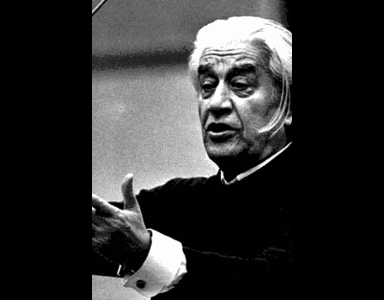
Conductors and the" hair on the back of your neck" test.

In the world of classical music, the impact the conductor of an orchestra has on a performance can be profound. In the life of this blog, I will often refer to those moments when during the course of a performance, either live or recorded, the hair on the back of your neck stands up, an uncontrollable smile takes over your face, a lump in your throat forms or tears of joy/sadness fill your eyes. Classical music has extraordinary power to move you. Jazz, rock, rap, country, Broadway... you name it... can all move a listener in many ways, but in my opinion, none can match the power and emotional depth of classical music. Not coincidentally, these amazing moments can be directly related to the decisions a conductor makes to interpret the piece of music he/she is conducting. The talent and effort of the musicians is absolutely part of this magical connection. So is the mood you may be in at that moment or.the emotions already filling your heart and mind.
On April 16, 1989, My dad and I drove to Chicago to see Sergiu Celibidache conduct the Munich Philharmonic Orchestra during their 1989 tour of the US. On the program was Mussorgsky's Pictures at an Exhibition. (I have a feeling just about everyone has heard some of the famous melodies from this epic work).
Celibidache had a very interesting career as a conductor, and was somewhat of a "fringe" artist with unorthodox attitudes and methods. He worked with Munich and other orchestras outside of the "big" name orchestras like Berlin, New York, Chicago etc...so he could impose his unique vision on musicians and audiences alike without as much push-back. He therefore did not achieve the popularity that some of his contemporaries like von Karajan, Ormandy, and Solti did. He did very little recording during his career because he did not believe it was possible to capture a performance as it was meant to be experienced live.
So there we sat in Orchestra Hall in Chicago on an April evening and witnessed a performance that made all of the hair on the back of my neck stand up....and put a giant smile on my face....and gave me a lump in my throat....and welled up tears in my eyes because I knew I was experiencing something special. My Dad and I turned to each other near the end of  Pictures at an Exhibition thinking there was nothing else he could do to blow our minds....only to be taken to yet an even higher level when the tubular bells at the very end soared above the already double fortissimo orchestra and sealed the memory forever in our ears, hearts and minds.
Knowing we had experienced something very special, we decided to be spontaneous and drive to New York City 5 days later to see him perform at Carnegie Hall. My then girlfriend, and now wife, Cheryl, joined my family for this trip. (she and my sister went to see Cats on Broadway while my mom and dad and I went to see Celibidache). Once again, he delivered an incredible performance. We were also able to attend an open rehearsal earlier in the day to see how he interacted with the musicians which was fascinating. And, best of all, the performance from April 16 in Chicago had been recorded and was released on CD a few years later, just before Celibidache passed away. You too can experience this incredible performance for yourselves on Youtube: Celibidache in Chicago. I was fortunate to be in the audience that night, feeling the hair on the back of my neck stand up.